Welcome to the official website of Shenzhen Zhihuang Technology Co., Ltd.!

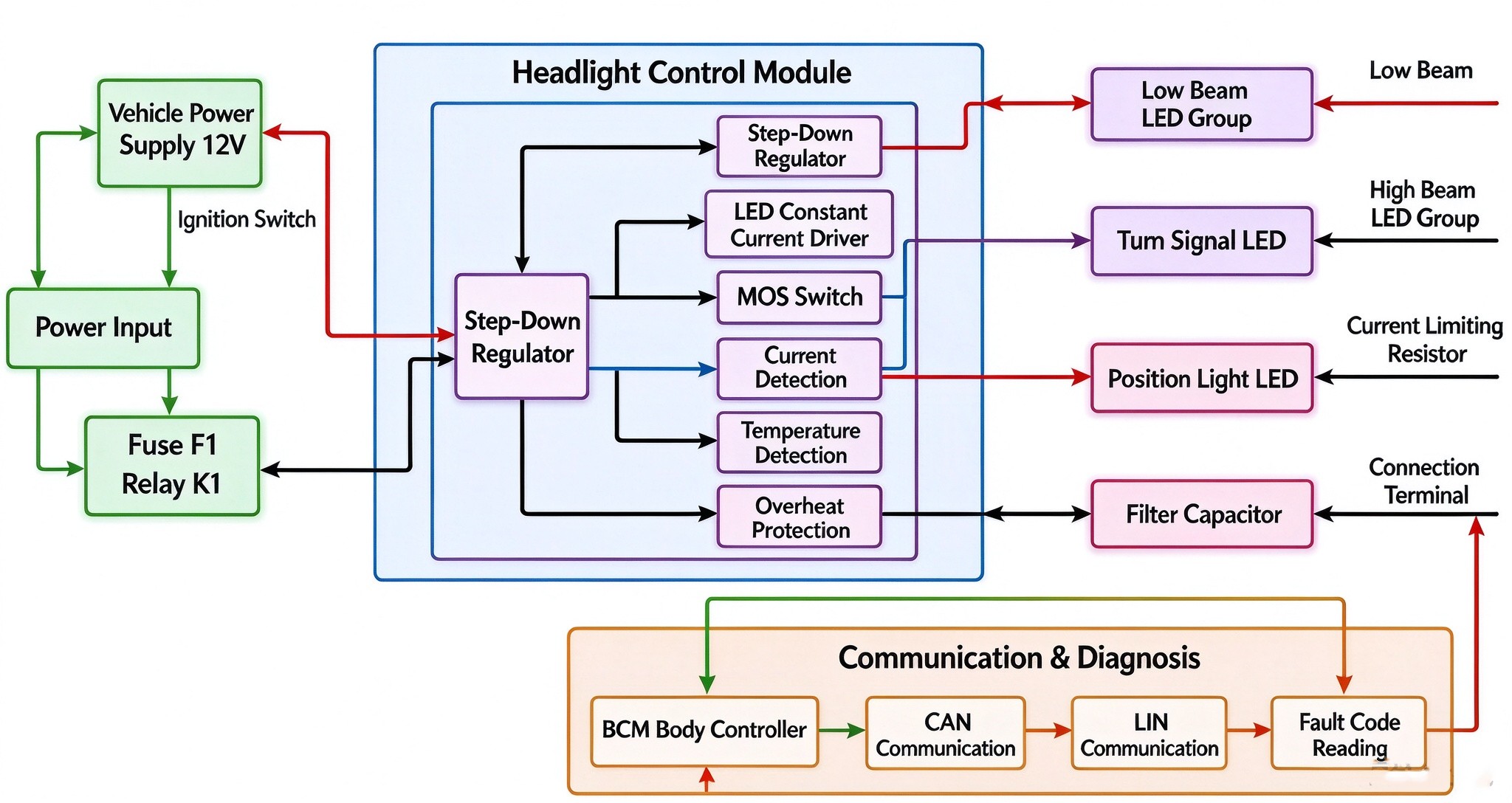
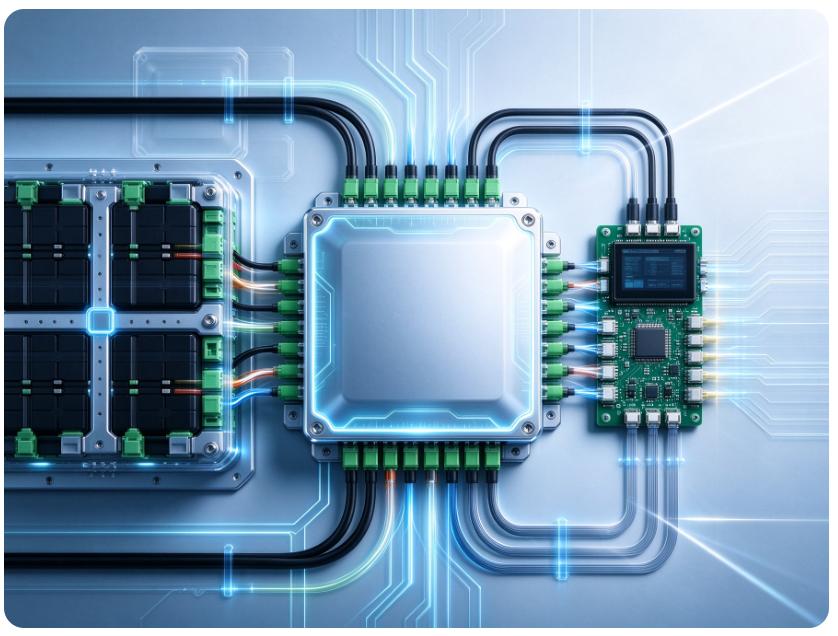
This plan focuses on the headlight control module and constructs a complete system for driving, monitoring, protecting, and communicating with the vehicle's LED lights. It achieves intelligent driving and collaborative control of low beam, high beam, turn signal, and position lights.
Front end power input unit: The power input link consists of a vehicle mounted 12V power supply, ignition switch, fuse, and relay. The ignition switch is responsible for powering on the system; Fuses and relays, as primary hardware protection, quickly cut off the circuit in case of short circuit or overload, protecting the rear headlight control module and providing a safe and reliable 12V input power supply for the entire lighting system.
Headlight control module: As the control core of the headlight system, it integrates power conversion, LED driving, signal monitoring, and safety protection circuits. The voltage regulator stabilizes the 12V power supply for vehicles, suppresses voltage fluctuations, and provides stable power supply for chips and LED loads; LED constant current drive outputs a constant current to maintain stable light brightness and extend LED lifespan; MOS switches, as power switching devices, receive commands to independently control the on/off of low beams, high beams, turn signals, and position lights; The current and temperature detection and overheating protection functions monitor the circuit current and module temperature in real time. Once overcurrent or overheating occurs, the output will be limited or cut off to protect the LED module and circuit.
LED light load unit: including low beam LED module, high beam LED module, turn signal LED, position light LED, matched with current limiting resistor, filtering capacitor, connector terminal.
Communication and Diagnostic Unit: The BCM body controller serves as the vehicle interaction node, which is linked to the LIN bus and headlight control module through the CAN bus. The CAN bus transmits light mode control commands and light working status. LIN bus supports fault code reading and device diagnostic calibration. The system can report fault information in real time, support vehicle diagnostic equipment to read faults, and facilitate maintenance and repair.
Tel: 0755-85280120
Email: georgeguan@goldone.com.cn
Head Office: Building 4, Room 505, Qianhai Kexing Science Park, Bao'an District, Shenzhen
Factory Address: 4/F, Building A1, Langxin Industrial Zone, Langxin Community, Shiyan Street, Bao'an District, Shenzhen