Welcome to the official website of Shenzhen Zhihuang Technology Co., Ltd.!

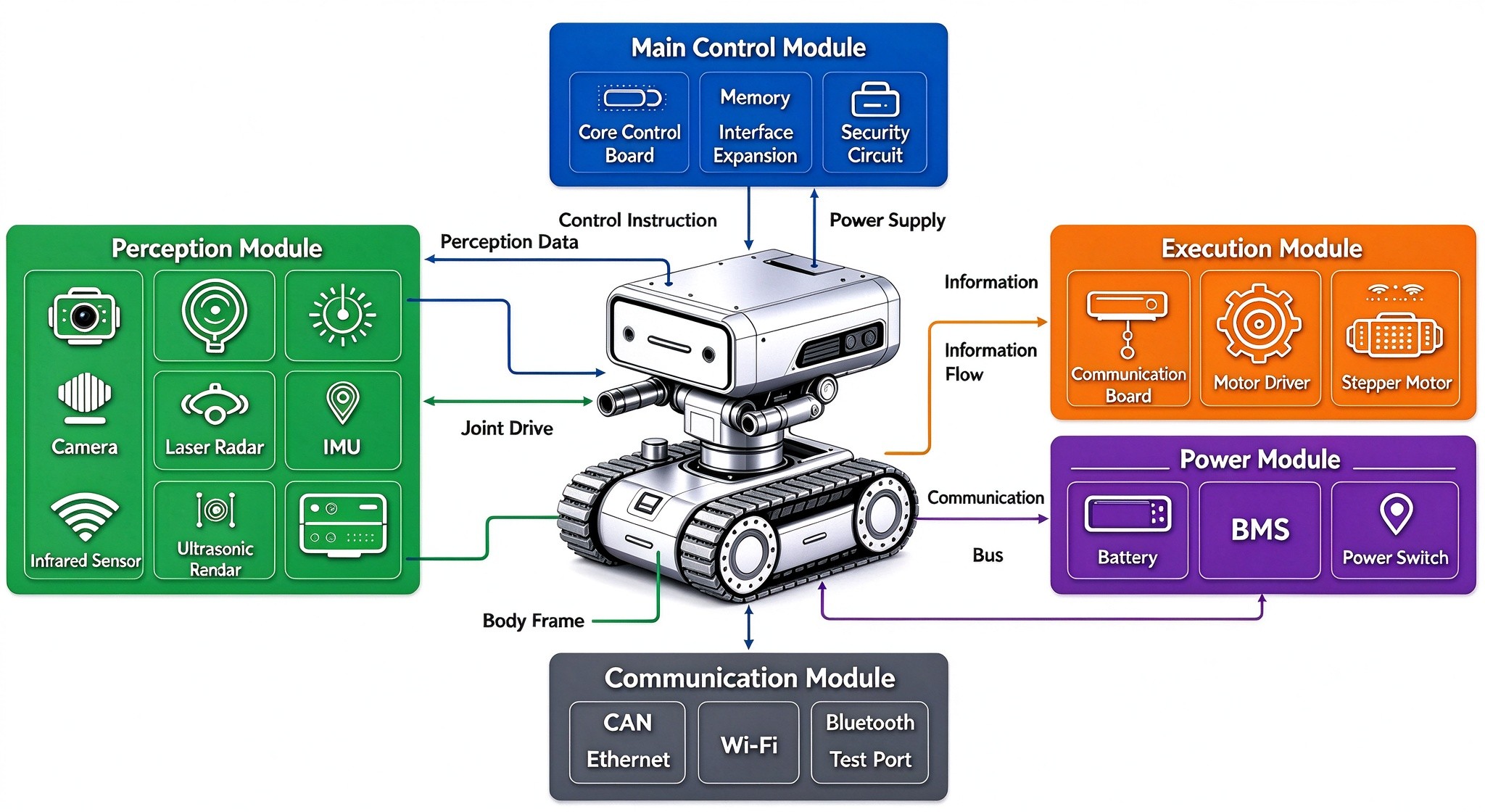
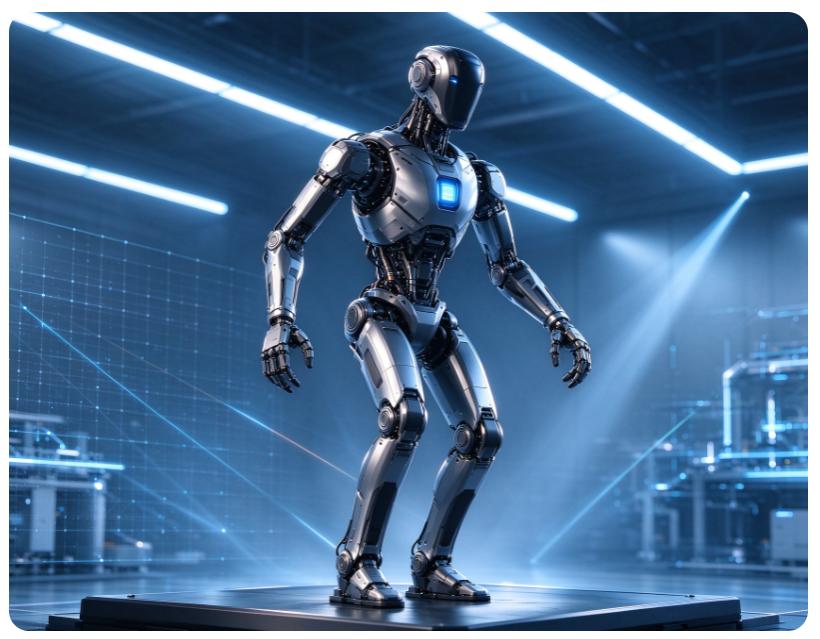
This robot solution adopts a modular architecture design, which divides the entire machine into five major units: the main control module, perception module, execution module, power module, and body communication framework. Each module is independently decoupled and coordinated, and has the characteristics of easy development, easy maintenance, and rapid scalability.
Main control module (system brain): integrates core controller, memory storage, interface expansion, and security monitoring unit. Responsible for overall task scheduling, algorithm computation, and logical decision-making; Receive environmental data from the perception module and issue control instructions to the execution module; Simultaneously managing the safety status of the entire machine and providing rich expansion interfaces to the outside world, it is the control center of the robot.
Perception module (environmental perception layer): equipped with various sensors such as camera module, LiDAR, IMU inertial measurement unit, etc. Real time collection of environmental and ontology state information such as images, spatial point clouds, posture, and position, forming multi-source perception data and uploading it to the main control module to achieve environmental recognition, positioning, and obstacle avoidance, providing a data foundation for robot autonomous action.
Execution module (action output layer): relying on the communication bus to receive main control instructions, the motor drive unit controls the joints and walking mechanism, and cooperates with the end effector to complete various job actions. Support motion control and homework operations to achieve tasks such as robot movement and grasping.
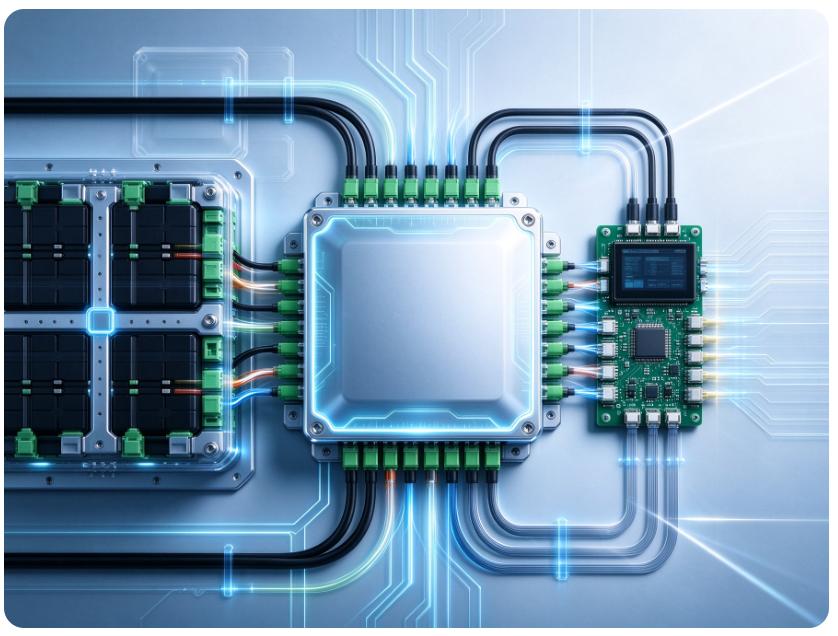
Power module (energy supply layer): composed of lithium battery, BMS battery management system, voltage reduction and stabilization circuit, and power switch. Provide stable and safe power output for all modules of the entire machine. BMS monitors the battery status in real-time to achieve battery protection and energy management, ensuring long-term stable operation of the robot.
Body frame (communication carrier): Built in multiple types of communication interfaces such as CAN, Ethernet, Wi Fi, Bluetooth, etc. Build a complete machine communication network to achieve data exchange between modules, support device networking and remote debugging, facilitate functional iteration and on-site maintenance.
Tel: 0755-85280120
Email: georgeguan@goldone.com.cn
Head Office: Building 4, Room 505, Qianhai Kexing Science Park, Bao'an District, Shenzhen
Factory Address: 4/F, Building A1, Langxin Industrial Zone, Langxin Community, Shiyan Street, Bao'an District, Shenzhen